
No Body No Problem Clean Evidence Guide
How to clean evidence in No Body No Problem: work backward from the body, clean the carry route, avoid the fresh-patch tell, and leave the room looking normal.
Quick answer: Clean evidence in No Body No Problem by working backward from the body's final container to where the body started. Remove the blood and drag marks along the carry route, fix the furniture you disturbed, and stop before the room looks unnaturally clean. The official description specifically names a freshly cleaned floor as a clue, so over-cleaning is its own confession.
The game does not publish a cleaning-tool list in its store material. What it does publish is the cop's tell list: an open door, a broken object, a freshly cleaned floor, and strange behavior. That list is the best guide to what the cleaning layer is actually testing.
The four clues you are trying to remove
| Clue | How it appears | How to handle it |
|---|---|---|
| Blood | On the floor or near the body | Clean the trail, not one spot |
| Drag marks | Along the carry route | Follow the route backward |
| Disturbed furniture | Chairs, lamps, doors | Fix what is quick and quiet |
| A cleaned patch | A clean area in a dirty room | Avoid creating it in the first place |
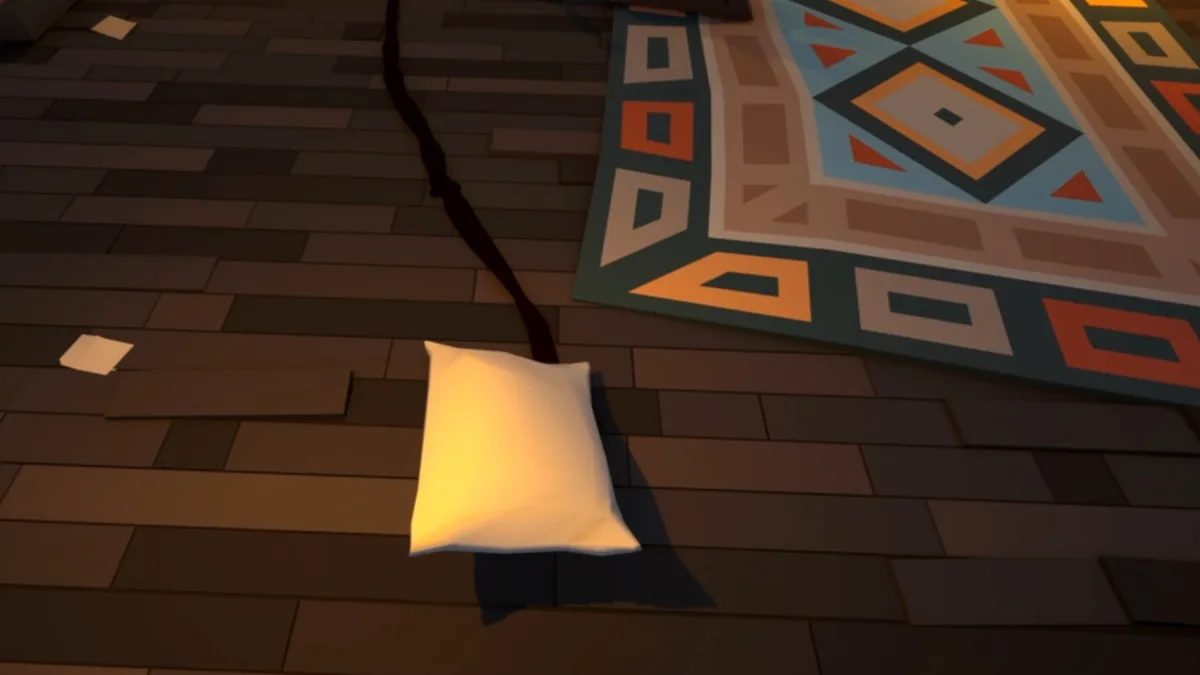
The first three are physical. The fourth is psychological: the cop sees that something was cleaned and knows where to look. A perfect cleaning job is therefore not perfect. It is a sign.
Work backward, not forward
Start at the container. Look back along the path the body took. Clean from the container toward the original position. That order keeps you from walking through a clean area with bloody shoes and re-dirtying it.
A practical sequence:
- Put the body in the container and close it.
- Check your own route for blood and marks.
- Clean the segment nearest the container first.
- Move backward toward the body's original position.
- Fix the furniture you moved on the way out.
- Leave the room from a different door if possible.
The last step matters. If you clean a trail and then walk back across it, you leave new marks.
Clean the trail, not the room
A room has a baseline level of mess. A single clean rectangle in the middle of a dirty floor is a spotlight. A cleaned trail that blends into the room's normal traffic is invisible.
That means:
- Do not mop the whole floor. It takes too long and creates a uniform clean surface.
- Do not scrub one tile repeatedly. The contrast is the clue.
- Do clean the threshold. Blood at a doorway is a route marker.
- Do clean the container's exterior. A bloody handle is a direct pointer.
The goal is "this room looks like it did before," not "this room looks new."
The store description lists a freshly cleaned floor as something the cop notices. If you clean one obvious patch, you have made the cop's job easier.
The order of operations
Cleaning competes with hiding and with the timer. A sensible order is:
- Hide the body first. A body in the open is an immediate loss; a stain is a clue.
- Clean the highest-contrast evidence. Blood on a light floor, a red smear on a white door.
- Fix the loud furniture. A knocked-over lamp is both a visual and an audio clue.
- Clean the route. Work backward from the container.
- Leave. Do not stand in the room admiring the work.
If the timer is low, skip the low-contrast evidence and leave. A suspect caught cleaning is worse than a faint mark the cop may not notice.
What not to clean
Some things are better left alone:
- A mess the cop already saw. Cleaning it now tells the cop you moved it.
- A normal clutter pile. Restoring it perfectly may look staged.
- The body's original outline. If the cop has not seen it, cleaning it is useful; if the cop is in the room, cleaning it is a confession.
- A stain under furniture. Moving the furniture to clean under it creates more disturbance than the stain.
The general rule: clean what points to the body. Leave what points to normal life.
Cleaning as the cop
The cop can use the same logic in reverse. A clean patch is a search marker. When you see one, do not stop at the patch; follow the line it belongs to. Check the nearest container and the nearest exit.
The cop's UV flashlight is the tool for residue that normal light hides. The official HUD shows it in slot 5. Use it on the floor around a clean patch, not in the middle of the patch.
Cleaning with a team
In a three-suspect team, one player should clean while another carries. The cleaner follows the carrier, not the other way around. That keeps the trail fresh and prevents the carrier from stepping on a cleaned section.
The third suspect should watch the cop. A cleaner who is surprised by the cop in the hallway has no story ready. A scout who calls out the cop's direction gives the cleaner time to switch to a normal task.
The co-op page→ covers the job split, and the hide body strategy→ covers the carry route.
When to stop cleaning
Stop when one of these is true:
- The timer is under 30 seconds.
- The cop is in the same room.
- The clean area is larger than the original mess.
- You have cleaned the same spot twice.
At that point, the best move is to put the cleaning item away, walk to a normal part of the room, and let the cop search. A suspect who stops cleaning at the right moment looks like a suspect who was never cleaning.
A knocked cushion or an open cabinet can be normal. A room with zero imperfections is not. Pick one small mess to leave and make it look like it belongs.
Official source: No Body No Problem on Steam ↗
Official source: Steam news feed ↗
Official source: PlayStation Store concept page ↗
FAQ
How do you clean evidence in No Body No Problem?
Work backward from the body's container to its original position. Clean the blood and drag marks along that route, fix disturbed furniture, and avoid cleaning one obvious patch.
Does cleaning leave a clue?
Yes. The official description lists a freshly cleaned floor as something the cop notices. Over-cleaning is a tell.
What should you clean first?
The highest-contrast evidence: blood on a light surface, a smear at a doorway, or a bloody container handle.
Should you clean the whole room?
No. Clean the trail and the container. A uniformly clean room in a messy location looks staged.
Can the cop see cleaned areas?
The cop can notice a freshly cleaned floor. The UV flashlight also reveals residue that normal light hides.
More No Body No Problem Wiki Guides
No Body No Problem Co-Op: Friends and Private Lobbies
No Body No Problem co-op is online four-player play with three suspects working together against one cop. Private codes and role rotation help a group.
No Body No Problem Controls and Keybinds
No Body No Problem controls: 1-5 select hand, knife, gun, handcuffs, and UV light; G drops, H grabs the radio, V talks, B emotes, and hold to cuff.
No Body No Problem Cop Guide
How to play the cop in No Body No Problem: search the edges, read doors and clean patches, use the UV light and cuffs, and pressure suspects without guessing.
No Body No Problem Demo: What Happened
A free No Body No Problem demo was announced on October 16, 2026, but its Steam page is not reliably visible now. Here is what the demo showed and how to check.
No Body No Problem Gameplay Explained
No Body No Problem gameplay is physics-based social stealth for four players: three suspects hide a body while one cop reads the scene. Here is the loop.
No Body No Problem Hide Body Strategy
A practical No Body No Problem hide body strategy: scout the route, pick the container, carry in short legs, clean the trail, and keep a fallback spot.
No Body No Problem Hiding Spots by Map
The best No Body No Problem hiding spots by location: apartment closets, shop shelves, car park vehicles, and the suburban grill, shed, bushes, and pool area.
No Body No Problem Hiding Spots Tier List
A No Body No Problem hiding spots tier list: shed and stockroom lead, car trunks and closets are solid, while the grill, bushes, and pool are risky decoys.